Different types of semiconductor devices drive the production of a wide range of applications, from basic gadgets to the most advanced communications systems. Understanding their functions allows us to choose the right components for any project or application.
But what exactly is a semiconductor device? In this article, we'll not only explain what it is, but also analyze the six main types and highlight their uses with examples.
This will give you an overview of how these components power today's technology and help you choose the right ones for your projects.
Read on!
What are Semiconductor Devices?
Semiconductor devices are electronic components made from materials that have an electrical conductivity intermediate between that of a conductor (such as copper) and an insulator (such as glass).
These devices control the flow of electrical current by exploiting the unique properties of semiconductors, such as silicon or germanium.
They are essential to modern electronics, enabling amplification, switching, and energy conversion in circuits.
In short, semiconductor devices are electronic components that use semiconductors.
What are semiconductors?
Semiconductors are materials with electrical conductivity intermediate between that of conductors and insulators. This unique property allows them to control electric current like neither conductors nor insulators.
In a semiconductor device, small adjustments in voltage or current can cause significant changes in the device's behavior, making them ideal for switching, signal amplification, and power control in electronic systems. These devices are essential for everything from power management in household appliances to complex data processing in computers and smartphones.
The ability of semiconductor materials to conduct electricity is often modified by adding impurities, a process called doping, which creates regions in the material with different electrical properties.
These regions allow semiconductor devices such as diodes and transistors to regulate current, making them essential in modern electronics.
6 Types of Semiconductor Devices and Their Applications
- Discrete Devices
Discrete semiconductor devices are individual electronic components with a single function. They are critical building blocks in electronic systems, performing essential operations such as switching, amplification, and rectification. Some of the most common discrete devices include:
- Diodes
- Transistor
- Thyristors
- Modules
Let's find out more about each of these components:
- Diodes
The diodes They are unidirectional electronic valves that allow current to flow in only one direction. Their most common application is rectification, or the conversion of alternating current (AC) to direct current (DC). They are used in power supplies, battery chargers, and signal demodulation.- Example: In a power circuit, diodes prevent reverse currents, protecting sensitive components from damage.
- Transistor
Transistors They are essential for amplifying and switching electronic signals. There are two main types: bipolar junction transistors (BJTs) and field-effect transistors (FETs). BJTs are often used for amplification, while FETs are primarily used for switching applications due to their high efficiency.- Example: Transistors are commonly found in processors, amplifiers, and switches. In a computer CPU, transistors process binary data by acting as tiny switches.
- Thyristors
Thyristors They are devices that act as bistable switches, conducting when their gate receives a current pulse and continuing to conduct as long as they remain forward-biased. They are particularly useful in high-power applications such as motor speed controls, light dimmers, and pressure control systems.- Example: Thyristors are often used in power electronics, such as in industrial motors and AC power control systems.
- Modules
Modules are assemblies of semiconductor devices, typically containing multiple components such as diodes, transistors, and thyristors, housed in a single package. They are used in applications requiring high power and efficiency, such as inverters and energy conversion systems.- Example: Power modules are used in solar inverters to convert DC power from solar panels into AC power for home use.
2. Optical Devices
Optical semiconductor devices convert electrical signals into light or light into electrical signals. These devices are essential in communications systems, sensors, and display technologies. The main types of optical devices include:
- Light Emitting Devices (LEDs)
- Photodetectors
- Composite optical devices
- Optical Communication Devices
Light-Emitting Devices (LEDs)
LEDs generate light when current passes through them, making them highly efficient for lighting and display technologies. LEDs are widely used for their long life, energy efficiency, and environmental benefits. - Example: LEDs are the basis of modern display systems, including those used in TVs, smartphones, and advertising screens.
Photodetectors
Photodetectors, such as photodiodes and phototransistors, convert light into electrical signals. They are crucial in sensing applications, such as cameras, optical mice, and solar cells. - Example: Photodetectors are an integral part of fiber optic communication systems, where they convert light signals into electrical signals.
Composite optical devices
Composite optical devices combine multiple functions, such as sensing and light emission, into a single package. They are essential in complex optical systems where space and performance are key considerations. - Example: In optical data transmission systems, composite devices can send and receive light signals, ensuring fast and reliable communication.
Optical communication devices
These devices transmit data using light. They are essential in high-speed internet systems, data centers, and long-distance communications networks. The speed and efficiency of optical communication devices have revolutionized the way data is transmitted globally. - Example: Fiber optic networks use optical communication devices to transmit massive amounts of data at the speed of light, ensuring high-speed internet connections.
3. Microwave Devices
Microwave semiconductor devices operate at very high frequencies (above 1 GHz) and are used for applications such as radar, wireless communications, and satellite transmission. These devices can be classified into :
- Discrete microwave devices
- Microwave Integrated Circuits (ICs)
- Microwave Modules
Discrete Microwave
Devices Discrete microwave devices, such as Gunn diodes and IMPATT diodes, are used to generate and amplify high-frequency microwave signals. These are essential in radar systems and wireless communications technologies. - Example: Gunn diodes are used in police radar to measure vehicle speed by generating microwave signals that reflect off moving objects.
Microwave ICs
integrate multiple functions, such as signal generation, amplification, and filtering, into a single chip. They are used in cell phones, satellite communications systems, and military radar systems. - Example: Microwave ICs in cell phones enable the transmission and reception of high-frequency signals, ensuring reliable wireless communications.
Microwave modules
Microwave modules are assemblies that combine multiple microwave components, often including both passive and active elements, into a single package. These modules are used in complex communications systems where space savings and high performance are essential. - Example: Satellite transponders use microwave modules to amplify and transmit signals from Earth to space and vice versa, ensuring clear, uninterrupted communication.
4. Sensors
Sensors are semiconductor devices that detect changes in environmental conditions and convert them into electrical signals. Sensors are crucial for applications in automotive systems, healthcare, industrial automation, and consumer electronics.
- Example: In automobiles, sensors detect parameters such as temperature, pressure, and speed, providing essential data to vehicle control systems for smooth operation.
Types of Sensors
- Temperature Sensors : Used in HVAC systems to monitor and control temperature.
- Pressure Sensors : Used in industrial applications to detect pressure changes in liquids or gases.
- Proximity Sensors : Used in consumer electronics, such as smartphones, to detect the user's proximity and automatically adjust functions such as screen dimming.
5. Integrated Circuits (IC)
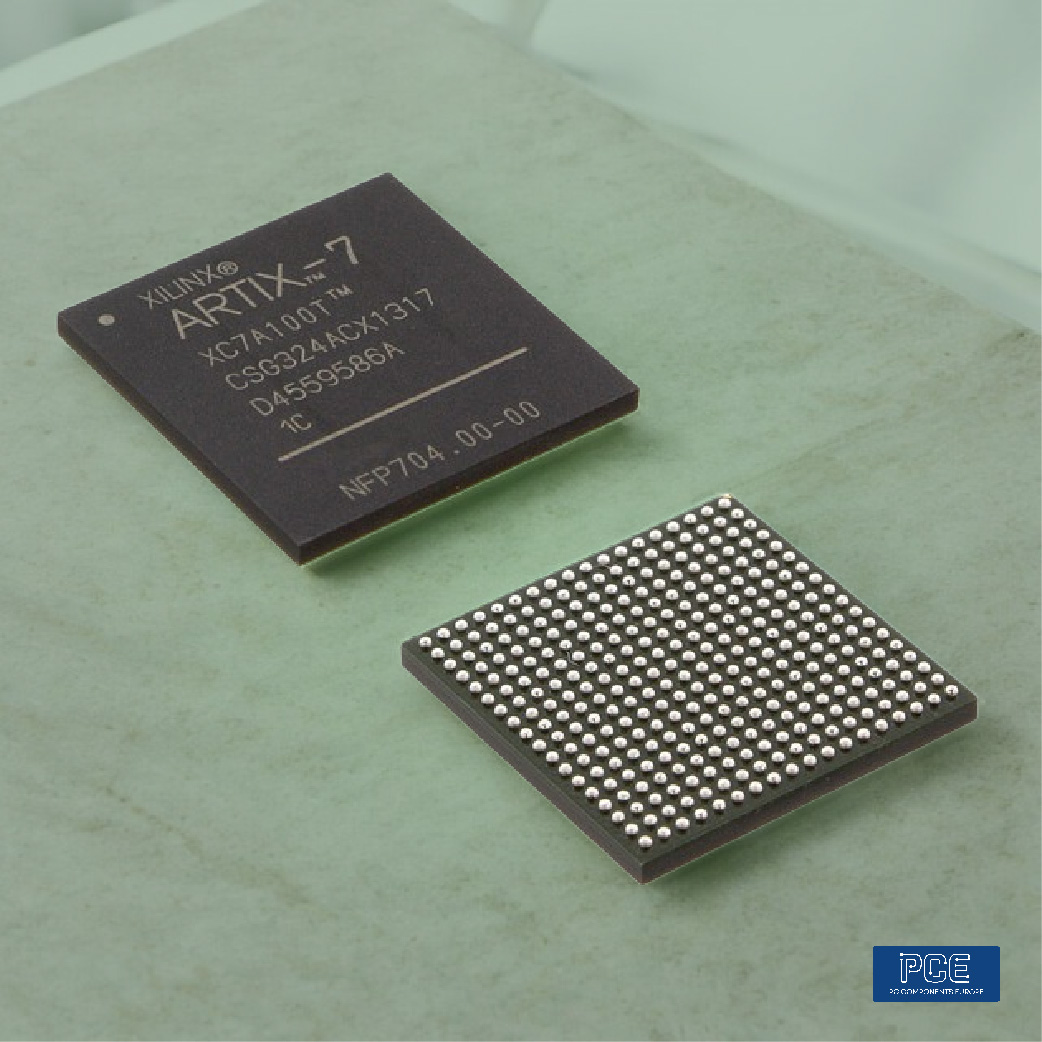
Integrated circuits (ICs) are semiconductor devices that integrate multiple electronic components, such as transistors, diodes, capacitors, and resistors, onto a single chip. They have revolutionized modern electronics by enabling more complex and compact designs. The main types of ICs include:
- Memories
- Microprocessors (MPU)
- Logic ICs
- Analog ICs
Memories
Memory ICs are responsible for storing data. This includes volatile memory (such as RAM) and non-volatile memory (such as flash memory). These ICs are essential in computers, mobile devices, and any other system that requires data storage.
- Example : Flash memory ICs are used in USB drives and SSDs for fast data storage and retrieval.
Microprocessors (MPU)
Microprocessors are the brains of modern electronics and control the operations of computers and smartphones. They perform arithmetic and logical operations, allowing devices to run programs and perform tasks.
- Example : The Intel Core series of microprocessors powers most computers and laptops, handling everything from web browsing to complex calculations.
Logic ICs
Logic ICs perform Boolean operations and are used in devices that require digital decision-making. They are essential in systems such as digital clocks, calculators, and more complex digital systems such as computers.
- Example : Logic ICs are used in computer systems to handle data manipulation and process control tasks.
Analog ICs
Analog ICs handle continuous signals and are used in audio processing and radio frequencies. These ICs are often used in audio systems, radio equipment, and sensors.
- Example : Analog ICs in audio amplifiers process sound signals to produce clear, amplified output in home audio systems.
6. Hybrid ICs
Hybrid ICs combine the advantages of multiple semiconductor technologies by integrating different types of components (such as transistors, resistors, and capacitors) into a single module. These ICs are ideal for applications where standard ICs cannot meet specific performance or design requirements. Hybrid ICs come in two main forms:
- Thin Membrane Hybrid ICs
- Thick Membrane Hybrid ICs
Thin Membrane Hybrid ICs
These ICs use a thin layer of conductive material, applied through a process called sputtering, to form circuits. They are often used in high-frequency applications and are highly customizable.
- Example : Thin-membrane hybrid ICs are used in aerospace systems, where compact size and high reliability are essential.
Thick Membrane Hybrid ICs
Thick-membrane ICs use screen printing to apply the conductive material. They are commonly used in power electronics and other applications where cost-effectiveness and robustness are required.
- Example : Thick-membrane ICs are used in automotive electronics to manage power distribution and control.
Find a Wide Range of Electronic Components for Your Projects at PC Components Europe
Discover a wide selection of diodes, transistors, thyristors, optical devices, microwave devices, sensors, ICs, capacitors, resistors, connectors, power modules, and relays, all available at PC Components Europe to meet your electronic and electromechanical needs.
Some of the components you can find at PCE include:
- Diodes
- 1N4148 – Fast switching diode (general purpose)
- 1N5408 – High Current Rectifier Diode
- BAS16 – Surface Mount Switching Diode
- BYV27-200 – Fast Recovery Rectifier
2. Transistor
- 2N2222 – General purpose NPN transistor
- 2N2907 – General purpose PNP transistor
- IRF540N – N-Channel
- BC547 – Small-Signal NPN Transistor
3.Thyristors
- BT136 – TRIAC for AC switching
- 2N5060 – Silicon Controlled Rectifier (SCR)
- TYN612 – SCR for medium power switching
- BTA41-600B – TRIAC for high-power applications
4. Optical Devices (LEDs, Photodetectors)
- CREE-XTEAWT-00-0000-000000H51 – High Power White LED
- LDR-5530 – Photodetector Light Sensor
- SFH320 – Phototransistor
- OSRAM-LW-W5SM – White LED for lighting
5. Microwave Devices
- MA4E1317 – GaAs Microwave Diode
- MRF947 – Microwave Transistor
- MAAL-011078 – Microwave Amplifier IC
- HMC630LP3E – GaAs MMIC (Monolithic Microwave Integrated Circuit)
6. Sensors
- MPX5010DP – Pressure Sensor
- TMP36 – Temperature Sensor
- HC-SR04 – Ultrasonic Distance Sensor
- BH1750 – Ambient Light Sensor
7. Integrated Circuits (IC)
- ATmega328P – Microcontroller IC (8-bit, AVR series)
- LM358 – Dual operational amplifier IC
- 74HC595 – Shift Register IC
- AD8232 – Heart Rate Monitoring Sensor IC
Click here and find out more about the 13 Best Microcontrollers on the market
8. Memory IC
- W25Q64JVSSIQ – 64Mb Flash Memory
- AT24C256 – 256Kb EEPROM
- MT48LC16M16A2 – 256Mb SDRAM
- IS25LP064A – Serial Flash Memory (64Mb)
9. Capacitors
- C3225X7R1E106K250AB – Multilayer ceramic capacitor, 10 µF
- EEU-FR1V102 – Electrolytic Capacitor, 1000 µF, 35V
- B43504A5477M000 – Plug-in electrolytic capacitor, 470 µF, 450V
10. Resistors
- CRCW080510K0FKEA – SMD Resistor, 10kΩ, 1%
- RS1/4-1K – Carbon Film Feed-Through Resistor, 1kΩ
- Y ageo RC0402FR-071KL – 1kΩ SMD Resistor, 1% Tolerance, 0402
- Vishay VR68000001005FA100 – Precision Wirewound Resistor, 100Ω
11. Connectors
- TE 282836-4 – 4-Position Wire-to-Board Connector
- Molex 39-30-3040 – 4-Position Header
- JST XH-2P – 2-pin connector
- Amphenol 97-3106A-14S-6 P – Circular Connector
12. Power Modules
- IRAMS10UP60B – Intelligent Power Module (IPM), 600V
- FOD8316 – Optocoupler driver for IGBT
- SPM3A60D – Motor Power Module, 600V
- PM25CLB060 – IGBT module, 25A
13. Relay
- G2R-1-E-DC24 – General purpose relay, SPDT, 24V DC
- G6A-234P-ST-US-DC12 – Signal Relay, 12V DC
- HF115F – Power Relay, 12V DC, 30A
- Omron LY2-DC12 – 12V DC relay, DPDT
Semiconductor Devices Are at the Heart of Modern Technology
They enable everything from smartphones to space exploration. Understanding the six main types of discrete devices—optical devices, microwave devices, sensors, ICs, and hybrid ICs—will help you make informed decisions when choosing components for your projects.
As you've read in this article, each of these devices has unique characteristics and applications, making them indispensable in a wide range of industries.
Have questions or want to find a specific semiconductor device?
Contact the PC Components team today!
References :
“Semiconductor Devices: Physics and Technology” by SM Sze
“Introduction to Semiconductor Devices” by Kevin F. Brennan
Toshiba Electronic Devices & Storage Corporation