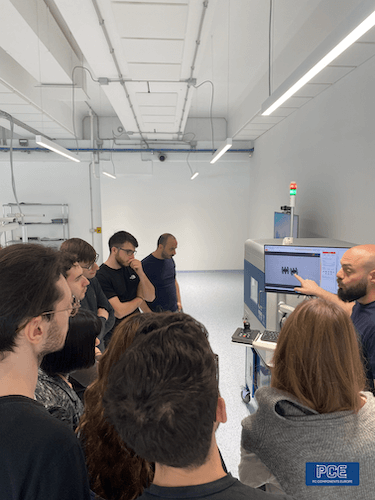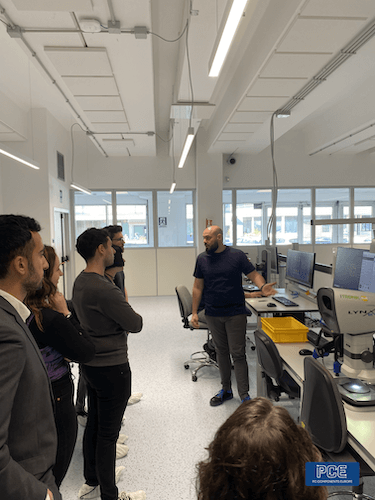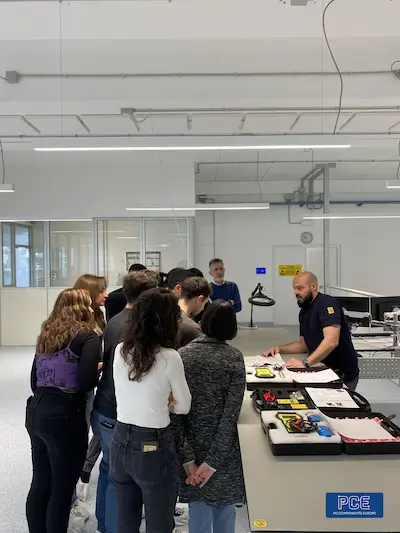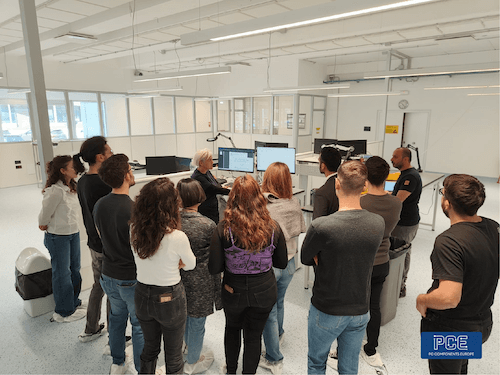
Today we're happy to share news about the University of Tor Vergata ! Last month, on April 18th, PCE hosted more than 20 students from the University of Tor Vergata, majoring in electronics. Our new facility, located at Via Orazio Raimondo 47, borders this leading university in Rome. Together with Professor Marcello Salmeri of the Department of Electronic Engineering, PCE and Tor Vergata are collaborating effectively. Professor Salmeri specifically teaches Electrical and Electronic Measurements.
The following PCE IDEA Certified Inspectors were present and provided a demonstration to the students of the University of Tor Vergata:
The goal was to show students how their field of study can be applied to the job market.
We walked the students through our quality control procedures, sharing our knowledge. We also focused on illustrating ESD measures and laboratory requirements, explaining how to properly and safely handle parts. Our ESD control program allowed us to achieve this goal. This ESD program was developed to comply with ANSI/ESD S20.20-2021 requirements.
What is the ESD Program?
An ESD Control Program , or Electrostatic Discharge Control Program, is a set of procedures and protocols designed to prevent damage to sensitive electronic components caused by electrostatic discharge (ESD). ESD occurs when two objects with different electrical potentials come into contact, causing a sudden flow of electricity between them. This discharge can damage electronic devices, especially those with integrated circuits or other sensitive components. An ESD Control Program typically includes:
- Provide training and education to staff on ESD awareness, prevention, and management procedures.
- Establish methods to ensure that ESD control measures are implemented effectively and in accordance with standards.
- Implement grounding systems to ensure that personnel, equipment, and surfaces are at the same electrical potential to prevent ESD.
- Designate specific areas where sensitive electronic components are handled, stored, or processed. EPAs are equipped with measures to minimize the buildup and discharge of static electricity.
- Use appropriate packaging materials and techniques to protect electronic components from ESD during transportation and storage.
- Clearly identify ESD-sensitive components and materials with appropriate labels or markings.
- Maintain records of training, audits, inspections, equipment calibration, and any ESD-related damage or non-compliance incidents.
“The ESD Control Program aims to mitigate the risk of ESD-related failures in electronic devices, ensuring product quality, reliability, and performance.” PC Components Europe.
We are grateful for the University of Tor Vergata's to our PCE Quality Department . We look forward to welcoming you back!