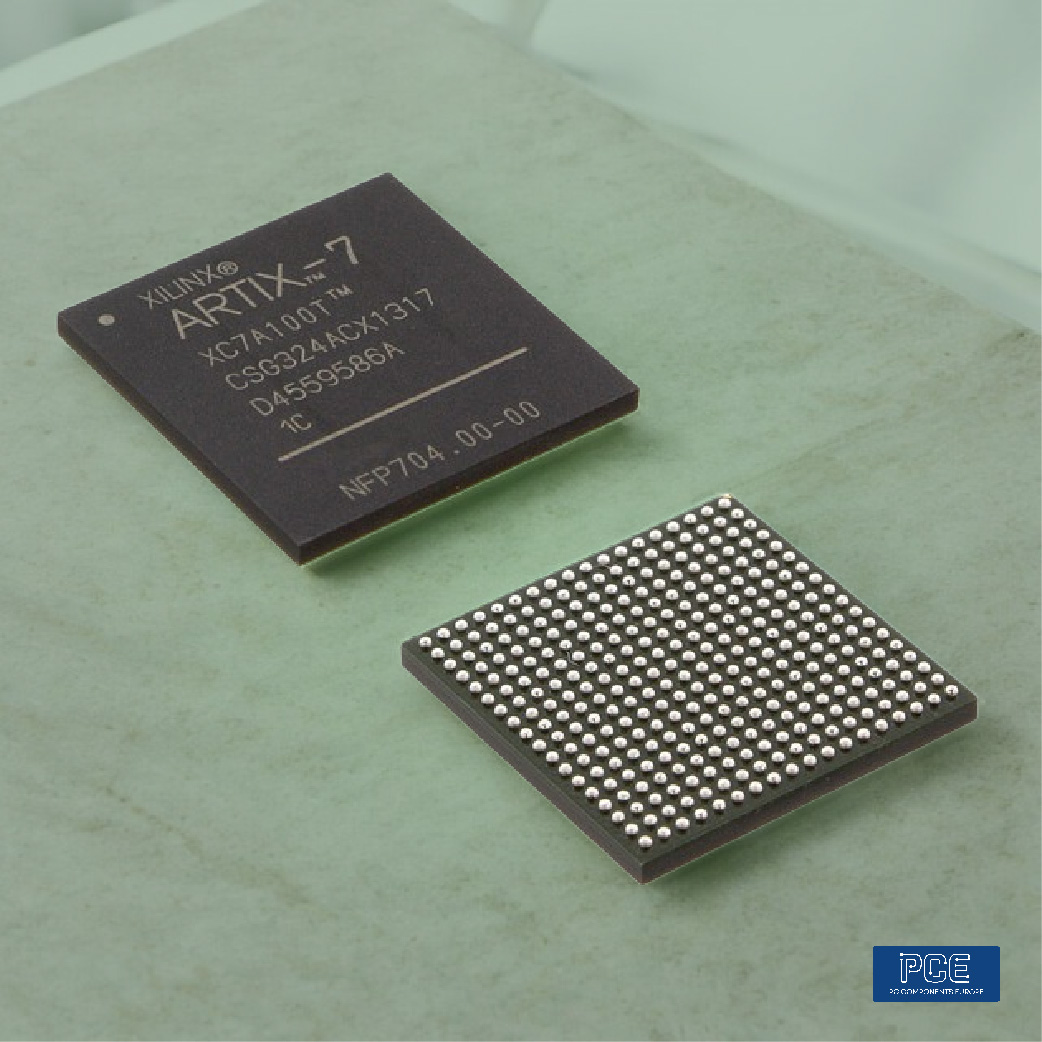
As artificial intelligence (AI) continues to transform industries, the demand for FPGAs for AI is rapidly growing. These versatile hardware solutions are becoming essential for developers and companies looking to optimize their AI applications.
This article will explore why FPGAs in AI are gaining traction, how they compare to other hardware options, and which FPGA products are best suited to your AI needs.
What is an FPGA and why is it important for AI?
A Field-Programmable Gate Array (FPGA) is a programmable hardware device that offers great flexibility, making it ideal for computationally intensive tasks, such as AI workloads. Unlike fixed-function devices like GPUs or TPUs, FPGAs can be reconfigured to meet specific AI application requirements, allowing for greater performance optimization.
AI models, especially deep learning ones, are increasingly complex, and FPGAs' ability to handle high-speed data processing, parallel computations, and low-latency operations makes them the ideal choice for many developers. Their reprogrammable nature also ensures the durability of AI systems , as they can adapt to new algorithms or architectures without requiring new hardware.
Why are AI applications increasing demand for FPGAs?
The increasing demand for FPGAs in AI is driven by several factors:
-
- Customization: FPGAs can be tailored to the specific requirements of AI models, optimizing performance where necessary.
-
- Low Latency: AI applications such as real-time video processing, autonomous vehicles, and robotics require fast decisions, and FPGAs excel at delivering low-latency performance .
-
- Energy efficiency: AI workloads often require high computational power, and FPGAs offer a more energy-efficient solution than traditional GPUs or TPUs.
-
- Edge Computing: As AI grows at the edge, where data processing occurs closer to the source, FPGAs provide the flexibility and processing power needed for real-time inference on edge devices.
These factors are leading more and more companies and developers to adopt FPGAs for AI, further increasing their demand.
FPGA vs. MCU for AI: Which One to Choose?
While FPGAs are gaining significant interest in AI applications, MCUs (Microcontroller Units) still play a crucial role in AI development, especially for low-power embedded systems. MCUs are often used for basic AI tasks such as processing sensor data in IoT devices .
However, FPGAs offer superior parallel processing capabilities and flexibility, making them a better choice for more intensive AI workloads.
The choice between FPGAs and MCUs depends on the specific requirements of your AI application. For real-time, high-performance AI tasks, FPGAs are the best choice.
For simple, low-power AI functions, MCUs may be sufficient.
Exploring FPGAs: From AI Applications to Versatile Industrial Solutions
Field-Programmable Gate Arrays (FPGAs) are increasingly used in a wide range of industries due to their flexibility and high performance.
While FPGAs play a significant role in AI applications such as machine learning inference and edge computing, their versatility extends far beyond AI.
AI and Machine Learning
FPGAs are highly regarded for their ability to handle demanding AI workloads with low latency.
They are ideal for tasks like real-time data processing, deep learning inference, and edge computing, making them a key component in areas such as autonomous vehicles, smart devices, and AI-based healthcare systems.
Telecommunications
FPGAs are crucial in telecommunications, particularly for 5G infrastructure, where they are used for real-time data processing and network adaptation, helping to manage high bandwidth requirements.
Aerospace and Defense
Because of their ability to provide high-speed, customized processing, FPGAs are used in aerospace and defense for radar systems, signal processing, and secure communications.
Medical Devices
Medical imaging, diagnostics, and real-time patient monitoring rely on FPGAs for their speed and ability to handle large amounts of data, ensuring accurate and timely results.
Automotive
In the automotive industry, FPGAs power advanced driver assistance systems (ADAS) by processing real-time sensor data to improve vehicle safety and automation.
Industrial Automation
From robotics to industrial automation, FPGAs support tasks like motion control and computer vision, providing the real-time performance needed in highly automated environments.

The best-selling and most requested FPGAs on PCE
Below is a list of the best FPGA options from major brands, suitable for AI and broader applications in telecommunications, aerospace, and more.
AMD FPGA (Xilinx)
AMD's Xilinx FPGAs are well known for their role in AI applications, but they are also versatile and suitable for a variety of industries, from embedded systems to data centers. Popular Xilinx FPGA families include Spartan, Artix, Kintex, and Virtex.
-
- Spartan: Entry-level FPGAs perfect for low-cost, low-power applications: XA7A35T-1CSG324I, XA6SLX9-3FTG256Q, XC7A100T-2CSG324I , XC7S75-1FGGA484C , XC7A200T-2FBG676I
-
- Artix: Ideal for mid-range and energy-efficient applications such as machine vision and communications: XCAU25P-2FFVB676E, XC7A15T-1FTG256C
-
- Kintex: Combines low power and high performance for applications requiring DSP, data center and networking: XCKU035-1FBVA676I, XCKU3P-1FFVB676E
-
- Virtex: High-end FPGAs designed for the most demanding tasks, including 5G infrastructure and aerospace: XCVC1802-1MSEVIVA1596, XCVE2302-2MSESFVA784, XCVC1902-1MSEVIVA1596, XCV50-5TQG144C
Intel FPGA
Intel FPGAs, formerly known as Altera, are designed to deliver high-speed processing in industries ranging from AI to telecommunications and beyond. Intel's most sought-after FPGA families on PCE include Stratix, Arria®, and Cyclone® , known for their flexibility and performance across a variety of industries.
-
- Intel Stratix: Delivers high bandwidth and processing power for advanced signal processing in defense and telecommunications: 1SG040HH3F35I2LG, EP1S80F1508C6N
-
- Intel Arria 10 GX : Ideal for parallel processing, this FPGA is highly regarded for AI inference, industrial automation, and signal processing: 1SG040HH3F35I2LG, EP1S80F1508C6N
-
- Cyclone® : Offers low-cost, low-power FPGAs for embedded systems, industrial control, and automotive applications: EP1C12F324I7N, EP3C25Q240C8N, 5CEBA4F17C8N, 5CGTFD9E5F31I7N
Lattice Semiconductor FPGA
Lattice Semiconductor specializes in low-power FPGAs, excellent for edge AI and broader applications like smart homes and industrial automation. Their focus on reducing development time and power consumption allows them to serve a wide range of industries, from telecommunications to automotive.
-
- MachXO: Series of low-power FPGAs designed for cost-sensitive applications such as interface bridging and control: LCMXO1200C-3TN100C, LCMXO1200C-3TN144I
-
- MachXO2: Improved version with greater flexibility and performance for I/O expansion and control tasks: LCMX02-256HC-4TG100I, LCMXO2-1200HC-4TG100I, LCMXO2-2000HC-4BG256I, LCMXO2-256HC-4SG48C
-
- ECP5: Combines high performance with low power consumption, perfect for industrial automation and video processing: LFE2M20E-5FN256CAAF, LFE2M20E-5FN256C, LFE2M20SE-7FN256C, LFE3-35EA-8FN484C
-
- XP: Ultra-low-power FPGAs ideal for battery-powered devices requiring energy efficiency: LFXP2-17E-5FTN256I, LFXP2-30E-5FT256C, LFXP2-8E-5TN144C
FPGA Microchip Technologies
Microchip Technology FPGAs are renowned for their reliability and low power consumption. These FPGAs find applications in both AI and non-AI sectors, such as automotive, telecommunications, and industrial automation.
-
- PolarFire: Known for their advanced security features, these FPGAs are ideal for real-time processing in embedded systems: MPFS250TS-1FCSG536, MPFS460T-FCG1152IPP
-
- SmartFusion: Combines an FPGA with a microcontroller, providing flexibility for automotive, industrial and medical applications: M2S090-FCSG325I, M2S010-1VF256, M2S050-FCSG325I, M2S005-VFG256I
-
- ProASIC: Flash-based FPGAs with in-system programmability, offering low power and high reliability, ideal for telecommunications and consumer electronics: AGLN250V2-VQG100I, AGLN125V2-VQG100I
-
- IGLOO: Ultra-low-power FPGAs designed for battery-operated devices such as portable electronics and industrial equipment: M2GL010-TQG144, M2GL010T-VFG256I, M2GL025T-1FGG484I, M2GL060T-1FGG484I, M2GL090T-1FGG484I
Find the components you're looking for on PCE
At PC Components Europe , we proudly offer a wide range of FPGAs from top brands, such as AMD, Xilinx, Intel, Lattice Semiconductors , and Microchip Technologies . Our products meet the highest quality standards , verified by our PCE Quality Laboratory .
For further information or inquiries, please feel free to contact our multilingual team , available in Italian, French, Swedish, Polish, English, Spanish, and Finnish . We're here to help you find the FPGA for your AI project !